


Receive money from abroad in Brazil


What receiving from abroad actually involves
PF or PJ: the structure changes your costs and taxes
What it typically costs
Common situations — where to start
- Freelancers and platform workers receiving from Upwork, Toptal, Deel or direct clients — see best platforms for freelancers to earn in USD.
- Remote employees paid in dollars by a foreign employer — see working remotely for foreign companies.
- PJ owners invoicing foreign clients — see how to receive USD as a PJ and taxes on service exports in Brazil.
- Individuals receiving a salary in dollars — see how to receive a USD salary in Brazil with lower fees.

How PJs get paid from abroad today
There are several ways to receive international payments as a PJ. All of them work — but they differ in cost, speed, and control. The right option depends less on the amount you receive — and more on how often you get paid and how much control you want when it comes to timing.
International bank transfers via SWIFT
Widely accepted and familiar, but often slow, expensive, and unpredictable — best suited to large payments.
Typical fee: $20USD+ and 4-8% markup on FX
Timeline: 1–4 business days

Payment platforms and digital wallets
Easier to set up and faster than traditional banks, but often include platform fees and forced conversion.
Typical fee: 1–3%
Timeline: 1 business day

Contractor and payroll solutions
Designed for recurring international income and used by companies with centralized HR teams.
Typical fee: Varies by platform
Timeline: 1–4 business days


How PJs get paid with Ruvo
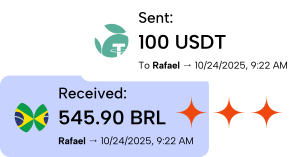
With Ruvo, PJs get a US bank account to receive funds via ACH — a free US payment system — from companies and clients. Move money between Brazil and the world in seconds: send, receive, and convert at real-time rates with 0% IOF.
Receive USD via ACH or Wire — Ruvo converts it to digital dollars
Fee: Free
Timeline: 1-3 business days
Receive USD via ACH or Wire — Ruvo converts it to digital dollars
Fee: Free
Timeline: 1-3 business days
Professionals ask whether it's better to receive money from abroad as a PJ or PF
The answer usually depends on scale and structure. We've done the analysis to help you figure out what's best for you.
PF vs PJ: receiving money from abroad
IOF on incoming payments
IOF charged when using traditional banking rails. With Ruvo, no IOF due to stablecoin settlement.
Exempt under Brazilian regulation for export of services.
Tax benefits (PIS / COFINS)
Not available for individuals.
Potential exemptions when income is registered as service exports and invoiced correctly.
Accounting & documentation
Individuals must manually organize records for tax reporting.
Business accounts support invoices, reports, and accounting records for compliance.
Operational control & Scaling
Simpler setup, but limited flexibility as income grows.
Greater control over cash flow, reporting, and long-term scaling. Simplified compliance.
Transfers to personal use
Direct usage, but fewer tools for managing timing and conversion.
Funds can be distributed to partners or transferred to personal accounts with proper support.
IOF on incoming payments
IOF charged when using traditional banking rails. With Ruvo, no IOF due to stablecoin settlement.
Exempt under Brazilian regulation for export of services.
Tax benefits (PIS / COFINS)
Not available for individuals.
Potential exemptions when income is registered as service exports and invoiced correctly.
Accounting & documentation
Individuals must manually organize records for tax reporting.
Business accounts support invoices, reports, and accounting records for compliance.
Operational control & Scaling
Simpler setup, but limited flexibility as income grows.
Greater control over cash flow, reporting, and long-term scaling. Simplified compliance.
Transfers to personal use
Direct usage, but fewer tools for managing timing and conversion.
Funds can be distributed to partners or transferred to personal accounts with proper support.
Send, receive & spend as a PJ with transparent fees and no IOF
Deposit and receive in BRL, get paid from abroad, or send to any crypto wallet — all from your digital dollar balance. Ruvo offers the best FX rate — the same one you find on Google, with no hidden markups. Just a small, flat fee per conversion, so you always know where your money goes.

- Free to receive USD and convert to USDT
- 0,3% offramp fee to convert USDT to BRL
- Convert when rates are best

- Receive USD via ACH and convert to USDT for free
- Send USDT to any Ruvo account for free
- Convert when rates are best
- Free to receive USD and convert to USDT
- 0,3% offramp fee to convert USDT to BRL
- Convert when rates are best
- Receive USD via ACH and convert to USDT for free
- Send USDT to any Ruvo account for free
- Convert when rates are best
Spend the way you earn.

Working internationally opens new opportunities
Working with international clients often means higher pay, better opportunities, and more flexibility.
Better compensation for your skills
Global rates typically exceed what local markets offer for the same work.
More stable, recurring income
International contracts often run longer and more predictably than local projects.
Freedom to work on your terms
You choose clients, projects, and schedules without geographic limits.


For Devs
Receive payroll from your employer using your Ruvo account.
- Receive in USD for a low cost
- Send to Pix or crypto wallets
- Withdraw instantly — no IOF, no hidden spreads.
What customers love about Ruvo
Hear how Ruvo transforms financial journeys
Saves money. The smartest option for CNPJs.

David Kang
Software Engineer, Turn.io

Ruvo simplifies our entire international financial workflow.

Joao Alvarenga
CEO, Antonnia AI

The best option for earning in USD.

Bruno Pazinato
Staff Engineer, Salsa
To receive money from abroad as a business in Brazil, you typically need to have an active company, provide your payment details to the payer, and use a financial institution or platform that processes international payments. Depending on the transaction, you may also need to provide company documents and information about the services rendered or the origin of the funds.
A freelancer can receive international payments through international transfers, foreign currency accounts, or payment platforms used by clients abroad. The process usually involves sharing billing or payment details, confirming the currency, and in some cases validating the professional activity or the account being used.
When receiving money from abroad, a Brazilian business may incur costs such as receiving fees, exchange rate spread, operational charges, and any fees related to how the transaction is structured. The total cost varies depending on the currency, country of origin, financial institution, and how the currency conversion is handled.
The main difference between receiving money from abroad as a business or as an individual lies in how the activity and income are structured. For those providing services on a recurring basis, operating as a business usually offers better financial organization and greater alignment with a professional operation. Receiving as an individual is generally more associated with occasional or non-business situations.
To get paid in U.S. dollars while working for companies abroad, you generally need to use an international payment setup that supports foreign currency payments. Depending on the solution chosen, the funds may be received in U.S. dollars before conversion or converted directly into Brazilian reais. It is important to evaluate fees, the exchange rate applied, settlement time, and the final net amount received.
The cleanest setup for multiple international clients is a business (PJ) account with a fixed US routing number and account number — the same details work for every client, regardless of which US bank they pay from. Ruvo provides these details on signup. You then invoice each client in USD and they pay by ACH or wire. If any client prefers crypto, a wallet address is also available.